This section of the guide provides an introduction to Indigeneity and Indigenous peoples (particularly those who reside in what is now known as the United States of America). In addition to this information, there is also a curation of selected resources on important and popular topics related to Indigenous Knowledge, peoples, and culture. This section of the guide is designed for a non-Indigenous audience, particularly those of settler descent with little to no pre-existing knowledge of Indigenous peoples, their histories, and contemporary issues.
 1491 (Second Edition)
by
1491 (Second Edition)
by
 Braiding Sweetgrass: Indigenous Wisdom, Scientific Knowledge and the Teachings of Plants.
by
Braiding Sweetgrass: Indigenous Wisdom, Scientific Knowledge and the Teachings of Plants.
by
 Everything You Wanted to Know about Indians but Were Afraid to Ask
by
Everything You Wanted to Know about Indians but Were Afraid to Ask
by
 Roxanne Dunbar-Ortiz's Indigenous Peoples' History of the United States
by
Roxanne Dunbar-Ortiz's Indigenous Peoples' History of the United States
by



 Smoke Signals
by
Smoke Signals
by
 More Than a Word: Native American-Based Sports Mascots
by
More Than a Word: Native American-Based Sports Mascots
by
 Prey
by
Prey
by
There are many definitions of Indigenous Knowledge, sometimes called Traditional Knowledge. Here are two:
Researchers that only use academic markers of authority (peer review, academic credentials, etc.) to evaluate information will find a one-sided perspective because academic sources are most often written about Indigenous communities rather than by them. Reliance on academic authority effectively silences many of the voices of Indigenous people on their own culture. Under this colonialist construction of knowledge, interpretation of Indigenous cultures is denied to members of that culture and reserved for those with academic authority. As Linda Tuhiwai Smith so searingly recounts in the introduction to her book, the Western monopoly on interpretation is incredibly painful to Indigenous cultures:
"It galls us that Western researchers and intellectuals can assume to know all that is possible to know of us... It appalls us that the West can desire, extract, and claim ownership of our ways of knowing, our imagery, the things we create and produce, and then simultaneously reject the people who created and developed those ideas...” (Tuhiwai Smith, 2012)
Western systems of knowledge appropriate and at the same time devalue information created by Indigenous ways of knowing. When working with Indigenous Knowledge in an academic context, it is vital to respect the authority, agency, and voice of Indigenous Knowledge. Do not treat Indigenous authorities as mere "informants," but rather as equals in the knowledge creation process.
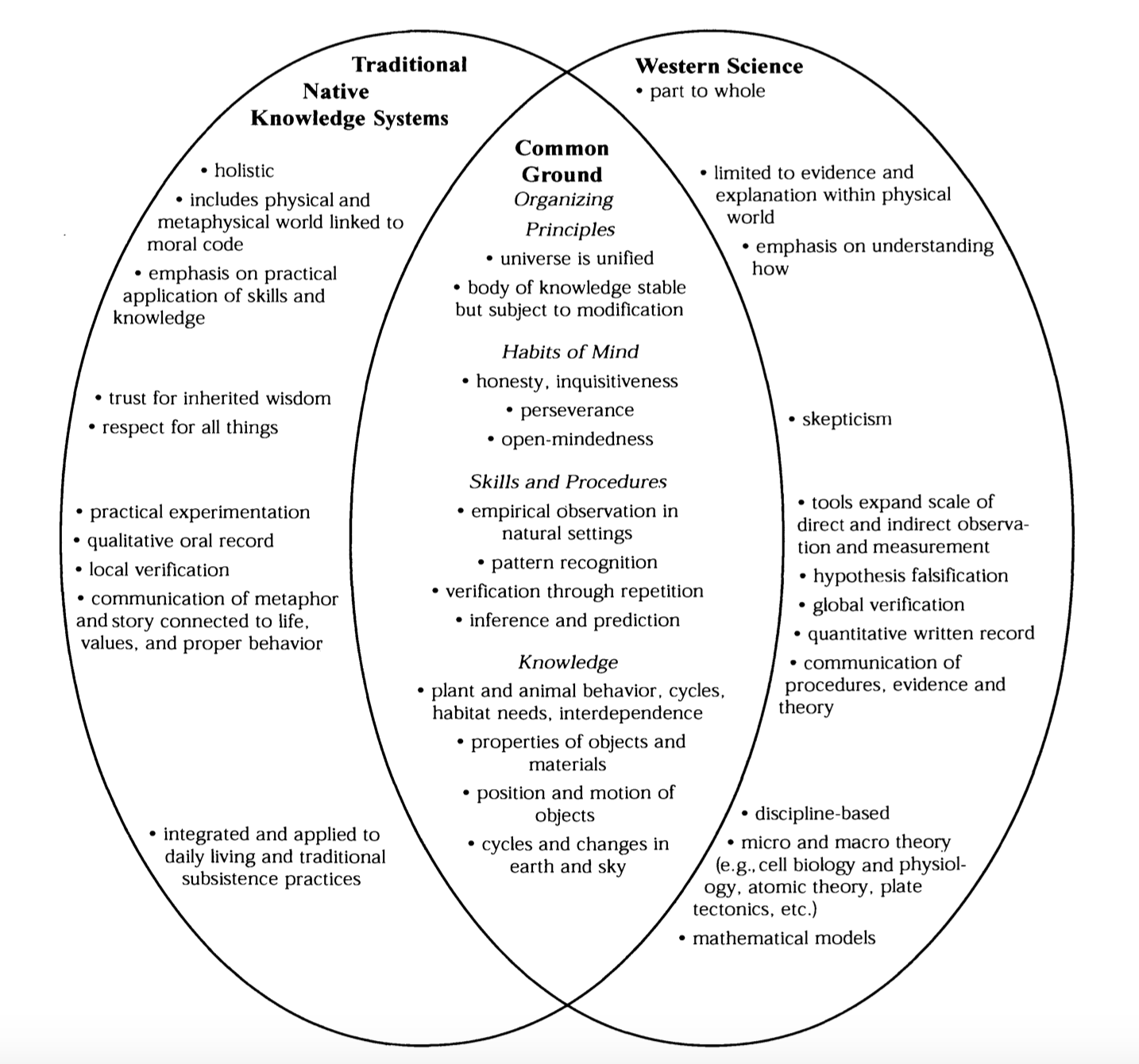
Indigenous Knowledge systems are diverse and multifarious, though they often share practices based on long histories of accumulated experiences with the world. The particulars and specifics of this knowledge are related to the whole as Native knowledge is often holistic and interrelated (Barnhardt and Kawagley, 2005). This knowledge is passed on through stories, demonstrations, and trial. Mastery depends on practical application of knowledge and indeed is tested through everyday survival:
“Knowledge is something you do; not a pre-existing tool independent of the person holding it, nor of the uses it might be put.” (Doxtator, 1996)
Western knowledge is typically compartmentalized, taught in detached and decontextualized settings, and indirectly measured with tests rather than judged based on one’s ability to put that knowledge into practice.
In traditional Native knowledge systems there is respect and trust for inherited wisdom, often communicated through an oral tradition, and for knowledge that has proved its utility in everyday practices. There is respect for stories that connect the particulars of knowledge to holistic worldviews, values, and life ways. Knowledge is often collective, evolving in a community of users, knowers, and actors. Authority is not conferred via systematic processes of Western bureaucracy, but rather through community decision making and respect for the knowledge and authority of elders (Barnhardt and Kawagley, 2005).
Used with permission from Stephens, Sidney. Handbook for Culturally Responsive Science Curriculum. Alaska Science Consortium and the Alaska Rural Systemic Initiative, 2000.
Indigenous Knowledge has often been misappropriated and misinterpreted by scientists and academics. Examples of the misappropriation of Indigenous Knowledge include:
Biopiracy - the appropriation of Indigenous knowledge of plants and natural resources by non-Indigenous scientists or for-profit companies, especially the pharmaceutical industry
Appropriation of symbols or art - this story explains the Indigenous origin of New Mexico’s state flag, a sacred symbol created by the Zia people, and shared by a non-Indigenous anthropologist without Zia consent or compensating the Zia. The Zia ask that permission be requested to use the symbol and that those using the symbol contribute to a scholarship fund for Zia children.
Appropriation of sacred land for research purposes - the summit of Maunakea on the big island of Hawai'i is sacred to the Hawaiian nation. It is also the site of 13 astronomy telescopes and the proposed location of a thirty-meter telescope, against the wishes and informed consent of Indigenous peoples. Native scientists advocate the creation of a Cultural Impact Assessment process and emphasize the need for historical context in STEM, with an awareness of the costs of research on marginalized communities that prioritizes the agency and decision-making of Indigenous groups.